
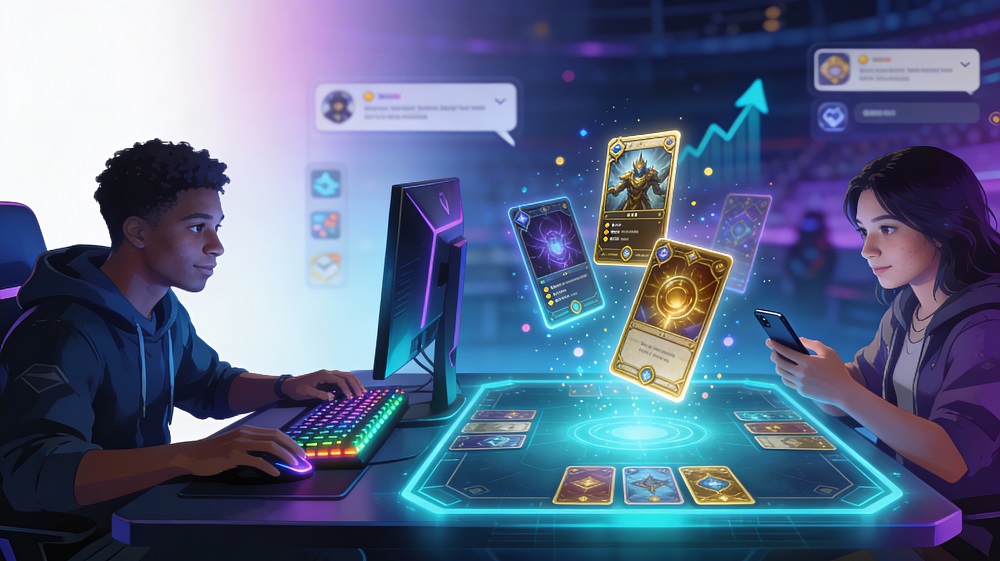
The digital card game genre has undergone a massive transformation over the past decade. What began as simple virtual recreations of physical tabletop card games has evolved into a multi-billion-dollar industry powered by complex mechanics, real-time strategy, and deep digital environments. As developers look for new ways to keep gameplay fresh, artificial intelligence has emerged as the defining technology shaping the next generation of digital card games.
AI is no longer just a simple computer opponent programmed to make basic moves. Modern machine learning, generative models, and procedural algorithms are overhauling every phase of digital card game development and play. From real-time balancing and automated playtesting to dynamic solo campaigns and adaptive opponent design, artificial intelligence is reshaping how these games are built, played, and sustained over time.
The Evolution of Artificial Intelligence in Digital Card Games
Early digital card games relied heavily on rigid, rule-based systems. Computer opponents followed strict decision trees, making fixed moves based on pre-programmed scripts. If a human player found a flaw in the code, the artificial opponent became easy to beat, offering little replay value.
Today, advanced machine learning models have replaced those static decision trees. Neural networks and reinforcement learning algorithms allow digital card game systems to evaluate thousands of potential hand combinations and board states in milliseconds. Instead of following fixed scripts, modern game systems learn through millions of simulated matches. This enables digital opponents to anticipate player strategies, adapt to unconventional decks, and execute complex tactics that mimic skilled human players.
Automated Game Balancing and Rapid Playtesting
One of the greatest challenges in digital card game design is maintaining balance. When developers release new expansions containing hundreds of unique cards, unintended interactions are bound to happen. A single combination of cards can create an overpowered deck that dominates the competitive meta, driving players away and forcing developers to push out rushed balance patches.
Artificial intelligence is drastically changing how game studios handle playtesting and balance adjustments.
-
Mass Simulation Testing: AI agents can run millions of simulated matches in a matter of hours. By testing thousands of deck variations against one another, AI flags overpowered combinations, broken card loops, and underperforming strategies long before the expansion reaches public servers.
-
Predictive Meta Analytics: Machine learning algorithms analyze win rates, turn durations, and mana curves across simulated games. This gives designers detailed data on how a new card set will affect the overall competitive landscape.
-
Proactive Stat Adjustments: Rather than reacting to player outrage after an update, developers can use AI insights to fine-tune energy costs, health pools, and attack values during early development stages.
This automated approach dramatically reduces the development cycle for new card expansions while ensuring a healthier, more balanced competitive environment for casual and professional players alike.
Dynamic Card Generation and Procedural Content Creation
Generative AI and procedural content generation are breaking down traditional limitations in card design. Historically, every card in a game had to be manually illustrated, balanced, and coded by human developers. While human creativity remains essential, AI tools are expanding what is possible within digital card ecosystems.
Real-Time Procedural Card Creation
In roguelike deckbuilders and single-player modes, AI algorithms can now generate brand-new cards on the fly during a gameplay session. Based on your current deck archetype, playstyle, and match difficulty, the game can craft custom spells, minions, or equipment with tailored stats and unique passive abilities. This ensures that no two dungeon runs or campaign matches feel identical.
Algorithmic Art and Asset Production
Creating hundreds of distinct visual assets for expansive card sets requires substantial time and budget. AI-assisted art pipelines help indie studios and major publishers prototype card concepts rapidly. Developers can generate high-resolution card frames, thematic background textures, and character art concepts in a fraction of the time. This lowers the barrier to entry for independent game creators, leading to greater visual diversity across the genre.
Smarter Non-Player Characters and Adaptive Opponents
For players who prefer single-player modes, AI is elevating computer opponents from predictable training dummies into genuine tactical rivals.
Reinforcement Learning in Practice
Through deep reinforcement learning, non-player characters learn by trial and error across millions of hands. Instead of receiving artificial stat boosts or cheating by seeing the player’s hidden hand, modern AI opponents evaluate the visible board state, calculate probability matrices, and make optimal decisions using pure strategy.
Personalized Difficulty Scaling
Not every player wants a ruthless, grandmaster-level opponent. AI systems can assess a player’s skill level in real time by tracking win streaks, deck synergy efficiency, and decision-making speed. The AI then dynamically adjusts its playstyle—making slight strategic missteps against beginners to maintain fun, or executing precise counter-strategies against seasoned veterans seeking a tough challenge.
AI-Driven Deck Building and Personalized Player Analytics
As digital card games grow, card pools often swell into thousands of individual choices. For new or casual players, building a coherent deck out of a massive library can feel overwhelming. AI-powered collection management tools are helping players bridge this skill gap.
-
Contextual Deck Recommendations: Modern deck-building assistants evaluate your existing card collection and suggest optimal synergies based on current meta trends and win-rate data.
-
Synergy Detection: If you pick a core card around which to build, AI algorithms scan your library to highlight supporting cards that maximize its potential, explaining why specific synergies work well together.
-
Post-Match Tactical Analysis: Advanced AI coaching tools analyze completed matches, highlighting key turns where you made sub-optimal plays, missed lethal damage, or misused resources.
By demystifying complex deck construction and offering actionable feedback, AI keeps new players engaged without stripping away the strategic depth that card game enthusiasts love.
Fraud Prevention and Competitive Integrity
Maintaining fair play is critical for digital card games, especially those featuring ranked ladders, cash tournaments, and trading economies. Artificial intelligence plays a pivotal behind-the-scenes role in safeguarding competitive integrity.
Machine learning models continuously monitor gameplay telemetry to detect suspicious activity. AI algorithms can identify botting scripts designed to farm in-game currency by detecting mechanical input patterns, inhuman reaction times, and unnatural playing rhythms. Furthermore, in digital trading card economies, predictive algorithms monitor marketplace transactions to flag real-money trading, win-trading rings, and market manipulation scams before they disrupt the player base.
The Road Ahead: The Future of Interactive Digital Card Games
Looking forward, the intersection of artificial intelligence and digital card games will continue to push narrative and mechanical boundaries. We are moving toward a future where single-player card campaigns feature fully reactive non-player characters capable of dynamic dialogue, adaptive story arcs, and emergent quest lines tailored to how you play your cards.
Furthermore, dynamic card evolution could soon become a core mechanic. Imagine cards that gain permanent, AI-calculated traits or visual shifts based on your play history, turning your favorite deck into a truly unique personal artifact. As machine learning technology becomes more accessible, the boundary between fixed rules and living, evolving digital ecosystems will continue to blur.
Frequently Asked Questions
Will AI replace human game designers in digital card games?
No, AI is a tool that assists human game designers rather than replacing them. While AI can run simulations, suggest balance tweaks, and generate assets, human designers are still essential for creating compelling lore, designing core game mechanics, and ensuring the overall experience remains fun and engaging.
How does AI playtesting differ from traditional human playtesting?
Human playtesters provide valuable subjective feedback regarding emotional engagement, fun factor, and user interface clarity. AI playtesting focuses on raw data, executing millions of matches to find mechanical exploits, game-breaking bugs, and statistical imbalances far faster than human teams can.
Can AI card generators create balanced gameplay mechanics on their own?
Current AI systems can generate card ideas and mechanics based on rules fed to them, but they still require human oversight. Without clear constraints and algorithmic guardrails, AI-generated cards can easily introduce unplayable mechanics or game-breaking loops.
Does AI in digital card games make it easier for bots to cheat?
While bad actors can attempt to use automated scripts or AI overlay tools to play matches, developers use equally sophisticated security AI to detect these programs. Anti-cheat neural networks analyze input timing, decision patterns, and telemetry to catch and ban automated bots efficiently.
How do AI deck builders help beginner players?
AI deck builders analyze a beginner’s card collection and automatically construct competitive decks tailored to their available inventory. They eliminate the intimidating learning curve of manual deck construction, allowing new players to enjoy functional, synergistic decks right away.
Will future card games feature fully AI-generated campaign stories?
Yes, many upcoming digital card games are experimenting with generative AI narrative engines. These systems create dynamic storylines, unique quest encounters, and adaptive NPC dialogue that react directly to the choices you make and the cards you play during a campaign run.